7 Types of Student Accommodation in the UK (2026 Guide)
Updated April 2026
There are 7 main types of student accommodation in the UK: university halls of residence, purpose-built student accommodation (PBSA), private student halls, shared houses (HMOs), studio flats, homestays, and lodging with a live-in landlord. These are the most common types of student housing in the UK, each in cost, privacy, and lifestyle.
If you’re unsure which option suits you, you can read our complete guide to finding student accommodation for a detailed overview.
Choosing the right student accommodation options in the UK directly affects your budget, social life, and academic success. For example:
Around 68% of students report homesickness in their first term
Rent can take up 70%+ of a student’s budget
Security and location are top priorities for most students
Average costs range from £300 to £1,500 per month, depending on location and property type. First-year students usually choose university halls, while many international students prefer PBSA for comfort and convenience.
Quick Comparison: Types of Student Accommodation UK
Type
Avg. Monthly Cost
Best For
Contract Length
Key Perks
Social Level
University Halls
£400–£800
First-year students
40–52 weeks
Social life, bills included, Academic Proximity, Safety
High
Private PBSA
£500–£1,200
International students
44–52 weeks
Modern amenities (Gym, Cinemas, Free Printing stations), global community
Medium-High
Shared House (HMO)
£300–£600
Budget-conscious
6–12 months
Independence, lower costs, local experience
Variable
Studio Apartment
£700–£1,500
Postgrads/Privacy
12 months
Quiet, self-contained living, study-focused
Low
Homestay
£500–£900
Cultural immersion
Flexible
Meals included, family support, cultural training, and cost savings
Medium
Short-term rental
£200–£600 (weekly)
Short courses
Flexible
Flexible contracts, Fully Furnished, Global Standards
Source: 2023 National Student Accommodation Survey, UCAS
1. University Halls of Residence
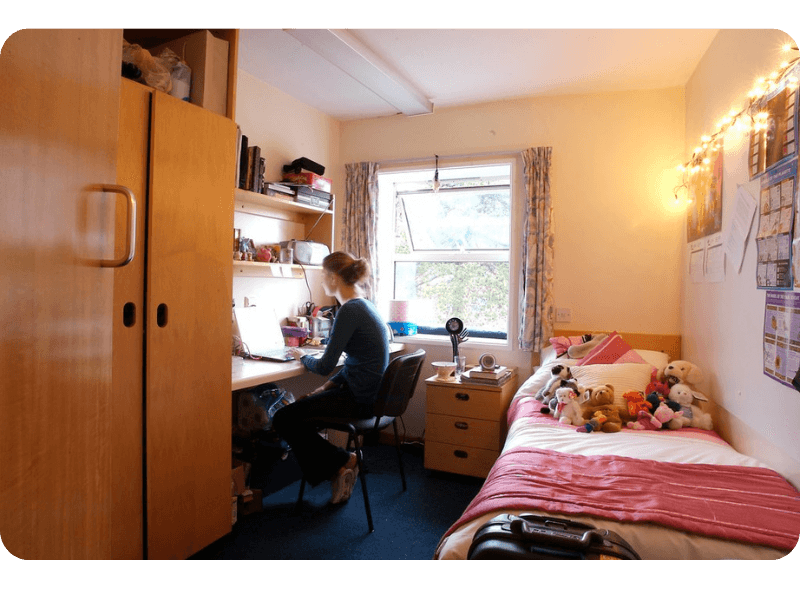
University halls are the most common types of university accommodation in the UK (2026). These are owned and managed by universities and usually located on or near campus.
They typically include furnished rooms with shared kitchens, and sometimes shared bathrooms.
Pros:
Close to campus
Bills and internet included
Strong social environment
On-site support and security
Cons:
Limited privacy
Shared facilities
Can be noisy
Best for: First-year and international students adjusting to life in the UK.
Expert Insight: “University halls help international students build their first support network. 92% of our first-years say it eased their transition.” – Sarah Wilkins, Accommodation Manager, University of Manchester
PBSA (Purpose-Built Student Accommodation) refers to modern housing designed specifically for students. This is one of the fastest-growing student accommodation options in the UK.
Modern buildings, often not university-owned, but specifically built for students wanting premium amenities like en-suite rooms or studio flats. Well-known brands include Unite Students, iQ, and Student Roost.
These buildings often include en-suite rooms, studios, gyms, and study areas.
Pros:
Top-notch amenities (study lounges, gyms, games rooms, cinema rooms)
All-inclusive rent (bills, WiFi, security)
Some offer en-suite bathrooms or studio flats
Great way to make friends across universities
Cons:
Can be more expensive than standard university halls
Sometimes less campus “feel”
Best for: International students and those wanting a bit more comfort and independence.
80% of PBSA have 24/7 security teams, and check for CCTV coverage.
The above are the main differences between university halls vs private halls
3. Shared Houses and Flats (HMOs) & Lodging/Live-In Landlord
A traditional house or flat you rent with a group of students, often moving in with friends for your second year or beyond. Managed by a landlord or agency. SpareRoom ( Ads by Landlord and Agencies ) or OpenRent ( Ads by Landlord only) to find housemates.
Pros:
Often cheaper than halls, especially in smaller cities
More independence—you pick your housemates
Flexibility in how you live
HMO housing (House in Multiple Occupation).
Off-campus student rentals with flexible leases.
Cons:
Bills usually not included (gas, electricity, water, internet)
Shared cleaning duties
Variable standards—important to check before you move in
Tips:
Use trusted websites like SpareRoom or OpenRent
Always view the property before paying any money
Step-by-Step for International Students to Choose Accommodation:
Use SpareRoom’s “Buddy Up” to find housemates
Verify landlord credentials via NRLA
Calculate true costs:
Rent: £300–£600
Bills: £90–£150 (energy, water, council tax exemption)
Internet: £25–£40
Red Flags to Avoid in Student Accommodation:
Landlords refusing virtual tours
Requests for cash-only deposits
No Tenancy Deposit Scheme registration
Expert Quote: “Always view properties in person. 60% of scams target students who pay deposits remotely.” – Sarah K., NUS Housing Advisor
Lodging / Live-In Landlord
This is a budget-friendly option where you rent a room in a landlord’s home.
Pros:
Lower cost
Bills often included
Quiet living
Cons:
Limited privacy
Restrictions on guests
Less student interaction
Best for: Students looking for the cheapest accommodation
HMO (House in Multiple Occupation) is a common option for second- and third-year students. This is one of the most popular forms of HMO student housing in the UK.
Students share a house or flat and split rent and bills.
Pros:
Lower rent
Choose your housemates
More independence
Cons:
Bills not included
Maintenance depends on the landlord
Shared responsibilities
Typical costs:
Rent: £300–£600/month
Bills: £90–£150/month
Best for: Budget-conscious students after the first year.
4. Studio & Self-Contained Flats
A single room with your own kitchenette and en-suite bathroom—perfect for those who value privacy.
Pros:
Complete independence & quiet study environment
No shared spaces to clean/maintain
Ideal for mature/postgraduate students
Good for quiet study and mature students
Cons:
Usually, the most expensive option (£1200–£1,800 per month in London)
68% require 12-month contracts
Limited social interaction opportunities
Can get lonely if you like company
Fewer are available for undergraduates
5. Homestays
Living in a private bedroom with a local family in their home. Often includes meals and all bills, with an average stay of 3-6 months
Pros:
Immersive cultural experience & language practice
Meals and bills included
Supportive home environment (helpful for improving English)
Great for under-18s requiring guardianship
Cons:
Less independence, may have curfews or house rules
Must adapt to family life
Limited guest policies
Expert Tip: “Homestays help combat homesickness. 78% of our international students report better cultural adaptation through this option.”
Best for: Short-term language students, under-18s, or those seeking strong cultural immersion.
6. Short-Term Rentals for Student Accommodation
This is a budget-friendly option where you rent a room in a landlord’s home.
Pros:
Lower cost
Bills often included
Quiet living
Cons:
Limited privacy
Restrictions on guests
Less student interaction
Best for: Students looking for the cheapest accommodation.
7. University-Managed Houses
Properties owned or vetted by the university, but not on campus. Like a hybrid between halls and private renting. Off-campus properties inspected by Uni staff, with 24/7 maintenance support, and the duration is an average 9-month contract
Pros:
Managed by the university—more secure and reliable
Bills sometimes included
Access to university support
Cons:
Limited spaces—typically for those who apply early. Only 12-15 properties per university
Strict occupancy rules (no subletting)
Less modern than PBSA options
Pro Tip: 92% of students who choose accommodation with 24/7 support staff report better stress management during exams. Always verify if your housing includes:
Emergency maintenance response times
Mental health resources
Parcel receipt services
Need help matching perks to your priorities? Use our Accommodation Selector Tool (simulated link) based on budget, location, and lifestyle needs!
Which Type of Accommodation is Right for You?
Choosing between the 7 types of student accommodation depends on three main factors:
Budget: HMOs and lodging are cheapest
Lifestyle: Halls and PBSA offer social environments
Privacy: Studios and private halls offer independence
Tips for International Students Choosing UK Accommodation
International students should consider more than just price when selecting accommodation.
Choose PBSA or halls for easier transition
Prioritise locations near campus or transport links
Look for 24/7 support and security
Confirm if bills are included
Avoid paying deposits without viewing
You should also plan your full UK living costs before committing to any housing option.
How to Choose the Best Student Accommodation for You?
Ask yourself what you consider while choosing student accommodation :
What is my budget (don’t forget utility bills if they’re not included)?
Do I want to be close to campus or the city centre?
Am I looking for a sociable environment or more privacy/quiet?
Am I staying for a whole year or just part of it?
How important is security and extra support?
Top Tips for Student Accommodation:
Book early! Rooms go fast in popular cities, especially before September.
Read every contract before signing—look for hidden fees, who pays the bills, and deposit terms.
Ask for help from your university’s accommodation or international student office.
Join student groups online to find housemates or advice.
Check trusted platforms and use only safe, protected payment methods.
Final Thoughts & Actionable Steps for Student Accommodation in the UK
Finding the right student accommodation in the UK can feel overwhelming, but you’ve got lots of options—each with its own perks.
Take these steps in the process of choosing student accommodation:
Start researching as soon as you accept your offer.
Decide your priorities: budget, location, independence, social atmosphere.
Use your university’s accommodation service and trusted rental platforms.
Connect with other international students for support and advice.
Remember: The sooner you start, the more choices you’ll have. If you get stuck, universities are there to help—email or call the student housing office. Good luck and get ready to enjoy your time in the UK!
Practical Tools & Resources for Student Accommodation
Some of the resources help you in the hunting process for the right type of student accommodation, as given below. If you are a full-time student, you will get some exemption that depends on the type of accommodation and the tenants’ role in your stay.
Essential Links related to UK Student Accommodation:
FAQ about Types of Student Accommodation in the UK
u003cstrongu003eWhat types of student accommodation are there in the UK?u003c/strongu003e
University halls, private halls (PBSA), shared houses/flats, studio apartments, homestays, short-term rentals, and university-managed houses.
u003cstrongu003eHow do I apply for student accommodation?u003c/strongu003e
Usually via the university’s accommodation office for halls, or directly with private landlords/providers for other types. Early application is recommended.
u003cstrongu003eIs it cheaper to live in university accommodation or private housing?u003c/strongu003e
University halls are often more expensive but include bills; shared private housing (HMOs) is usually cheaper but bills may be extra.
u003cstrongu003eCan I live off-campus as a first-year student?u003c/strongu003e
Yes, but most first-years choose on-campus university halls for the social and academic support.u003cbru003e
u003cstrongu003eIs a deposit required for student accommodation?u003c/strongu003e
Yes, most types require a deposit—university halls usually require a smaller holding deposit; private rentals require a larger tenancy deposit protected by a government scheme.
u003cstrongu003eAre bills included in student accommodation?u003c/strongu003e
Most university-owned and private halls include bills; shared houses/flats may or may not include them—always check your contract.
u003cstrongu003eCan couples or mature students stay in student accommodation?u003c/strongu003e
Some universities offer couples’ or family accommodation, but options are limited and require early application.
u003cstrongu003eWhat is the minimum length of a tenancy?u003c/strongu003e
University halls usually run for the academic year (40-52 weeks); private rentals can be 6-12 months, studio and short-term lets are more flexible.
You will receive a confirmation email with the meeting details.
Manage Consent
To provide the best experiences, we use technologies like cookies to store and/or access device information. Consenting to these technologies will allow us to process data such as browsing behaviour or unique IDs on this site. Not consenting or withdrawing consent, may adversely affect certain features and functions.
Functional
Always active
The technical storage or access is strictly necessary for the legitimate purpose of enabling the use of a specific service explicitly requested by the subscriber or user, or for the sole purpose of carrying out the transmission of a communication over an electronic communications network.
Preferences
The technical storage or access is necessary for the legitimate purpose of storing preferences that are not requested by the subscriber or user.
Statistics
The technical storage or access that is used exclusively for statistical purposes.The technical storage or access that is used exclusively for anonymous statistical purposes. Without a subpoena, voluntary compliance on the part of your Internet Service Provider, or additional records from a third party, information stored or retrieved for this purpose alone cannot usually be used to identify you.
Marketing
The technical storage or access is required to create user profiles to send advertising, or to track the user on a website or across several websites for similar marketing purposes.










Shreyansh Patel
Super helpful!